
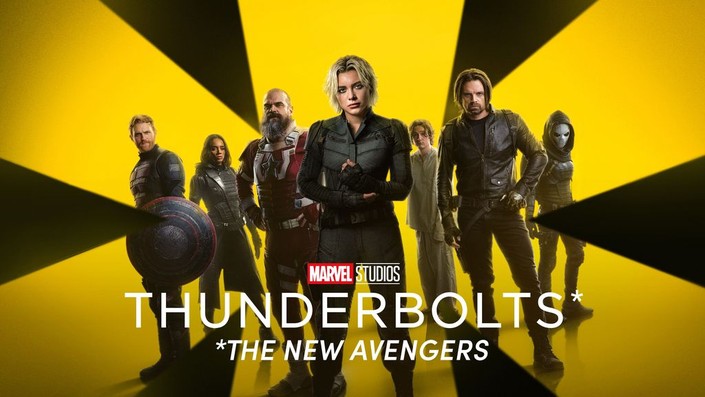
Title: Thunderbolts*
Director: Jake Schreier
Year: 2025
Spoiler Alert: HIGH
TL;DR Summary & Verdict
Rating: 7/10 – A welcome shift in tone, with genuine thematic weight in Sentry’s void and a band of anti-heroes with genuine people-problems. But it’s still Marvel — safe, calculated, and terrified of going all in.
Thunderbolts arrives as Marvel’s latest attempt to refresh its universe, this time focusing on a team of misfits and former villains cast into reluctant heroism. The premise suggests complexity—characters torn between past crimes and present redemption—but the execution is safer: most are quickly recast as good rather than truly conflicted. The film hits hard on the surface: explosive action, a couple of sharp performances, and Sentry’s Void, whose fractured mind and terrifying powers carry real weight. Threads of mental health, emptiness, and belonging run through the story, but they don’t stay long before being pushed aside for Marvel’s usual spectacle. By the end, you can see where it’s going—the beats are familiar, the emotions thin, the lineup too crowded. Still, there are sparks worth noticing: a darker mood, vailed political and cultural commentary, and moments that feel unexpectedly raw. When it’s over, Thunderbolts looks like another polished Marvel entry—steady, safe, and more step than leap.
Plot Synopsis
The film throws together a rough lineup of antiheroes—Yelena Belova, Bucky Barnes, Red Guardian, and the rest—working under Valentina Allegra de Fontaine. They get the jobs no one will touch, stuck between loyalty, survival, and whatever scraps of redemption they can find.
At the centre is Sentry. He’s both terrifying, and fragile. His power shows up as a darkness that swallows people whole, forcing them to relive their worst memories. He’s damaged, but he feels real—shaped by years of abuse, addiction, and trauma that never let go. He comes across as dangerous and tragic, but also potently sympathetic.
The rest of the Thunderbolts aren’t much better off. Each one carries scars of their own. Red Guardian clings to faded glory and a fractured family, Bucky staggers on as a survivor of an endless internal and external battle, and Yelena searches for purpose while her loyalties shift. Valentina sits above them, pulling strings, the kind of operator who bends every crisis into proof she should have more power.
The conflict builds through betrayals, explosive battles, and the Sentry’s collapsing mind. Yelena tells him to “shove it down,” but the story suggests otherwise: emptiness can’t be buried—it has to be endured together. By the climax, the team begins to lean on one another to keep isolation at bay. Sentry’s pain and sacrifice, unresolved and haunting, drives home the film’s darker point: that despair and heroism can exist in the same body.
It ends with the group battered but standing. The city is saved, though its people remain passive, waiting—as ever—for someone else to do the saving.
Craft & Execution
Visual Composition & Style
- Slick and polished, with Marvel’s trademark spectacle.
- The shadow effects of the Sentry are eerie and memorable—voids swallowing light and people alike.
- The cityscapes feel alive, grounding the chaos in something recognizable.
Camera & Movement
- Overhead fight sequences are crisp and kinetic.
- Handheld shots in close combat inject grit, while sweeping motions capture the scope of destruction.
- The camera does not play a huge role apart from the action shots, as it is with other Marvel Movies.
Performances
- David Harbour’s Red Guardian brings humour and emotion, a washed-up hero still trying to matter.
- Julia Louis-Dreyfus as Valentina (Elaine no longer) grows into her role—slippery, manipulative, and occasionally complex.
- Yelena carries the heart of the team, even if her arc feels underwritten.
- Bucky is flat, a congressman in name only, his inner life absent.
- Wyatt Russell’s U.S. Agent is effectively hateable, but depicted well as angry and disillusioned.
- Sentry dominates: bipolar swings, trauma, sacrifice. A performance of depth rare in Marvel.
Story & Dialogue
- Predictable beats undermine suspense—you always know the “heroes” will prevail.
- Themes of trauma, mental health, and self-doubt lend some weight.
- The void sequences are unnerving, confronting characters with their worst memories.
- The dialogue occasionally hits: “You can’t outrun the emptiness.”
- The resolution leans on togetherness over force—love as the only answer to the void.
Cultural Context & Themes
Thunderbolts is about emptiness and what it does to people. The Sentry embodies that. His power is a void that swallows light and memory, but what makes him disturbing is the damage underneath. He carries abuse, addiction, and trauma he never escaped. His story raises harder questions: how do scars shape who we are, and can the darkness inside ever be destroyed? The film’s answer is no. Survival depends on connection. The refrain, you’re not alone, is simple, but it lands.
Politics thread through the story as well. Valentina is portrayed as a manipulator, dodging accountability and impeachment while and tightening her grip whenever a crisis erupts. She represents a culture that no longer trusts its institutions, where fear props up power and truth disappears as soon as it becomes inconvenient. Russians are given more dimension than usual—flawed but human, with families and love that complicate old stereotypes.
By the end, the film reflects a culture hungry for power but full of doubt. It critiques authority, shows empathy for the enemy, and taps into the desire to matter in a chaotic world. The Thunderbolts fight for purpose and redemption, but what lingers isn’t their victory. It’s the reminder that emptiness doesn’t go away—it can only be endured together.
 Cinema in context.
Leave a comment