
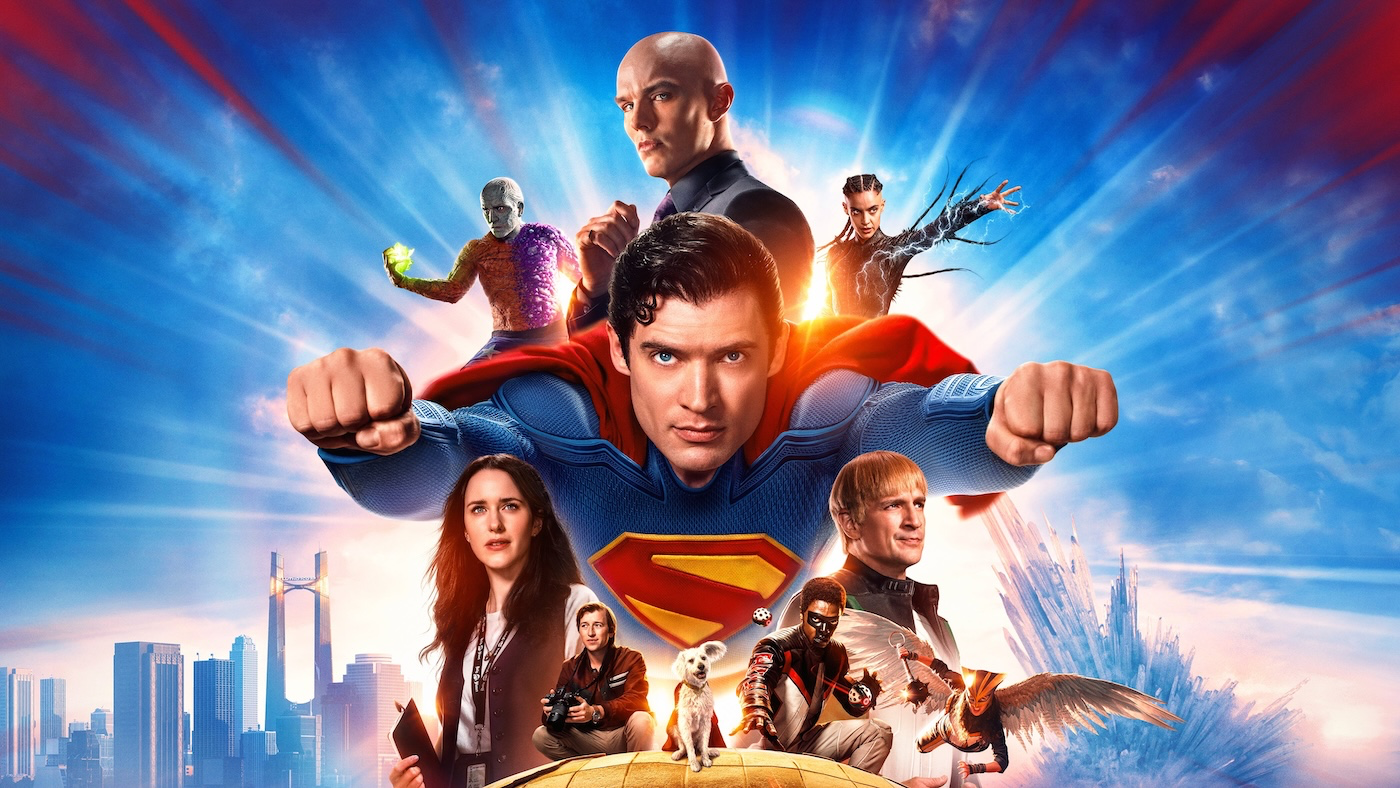
Title: Superman
Director: James Gunn
Year: 2025
Spoiler Alert: HIGH
TL;DR Summary & Verdict
Verdict: 6/10 — Superman kicks off DC’s new cinematic era with style and humour, delivering a polished but overstuffed spectacle that soars visually yet feels safe, underdeveloped, and still waiting to show its full strength.
James Gunn’s Superman arrives as the long-anticipated kickoff to DC’s new cinematic universe. Gunn, best known for his irreverent Guardians of the Galaxy films, brings some of that same energy here: a willingness to lean into the absurd, highlight overlooked characters, and lace the action with humour and music. This first outing sidesteps the origin story and drops us into a world where Superman is already a saviour figure, complete with Krypto the dog, Ultraman, and a host of supporting heroes and villains. The result is polished, energetic and fun, but lays flat amongst the backdrop of hero movies. Too many characters fight for limited screen time, emotional beats often feel underdeveloped, and the central romance never convinces. Visually, it soars.
Thematically, it gestures at corporate corruption, political conflict, and questions of power, but rarely cuts deep. Superman is a solid reset for DC—safe, serviceable, but pulling its punches.
Plot Synopsis
Gunn wastes no time retelling what everyone already knows. Clark Kent is already Superman, already famous, already worshipped as humanity’s saviour. The film opens in Metropolis with Superman balancing rescue missions, government scrutiny, and a strained relationship with Lois Lane. Their romance is rocky from the start—an argument disguising plot exposition makes clear they’ve been dating for months, but Lois resents his unilateral decisions about the fate of the world.
The rogues’ gallery is stacked. Lex Luthor, embodying corporate malice, imprisons innocents while plotting Superman’s downfall. Other Justice League figures appear—Green Lantern (Nathan Fillion, sporting a haircut that steals scenes), Element Man in full weirdness, and Mr. Terrific in a sharp Lois-perspective fight sequence.
The action jumps between Metropolis, Superman’s ice palace, and the Boravian conflict, a war over land that echoes present-day geopolitics. Superman faces both physical threats—metahumans, clones, alien weapons—and existential ones: his father urging him to dominate humanity, the public’s worship, the danger of becoming more symbol than man.
Threaded throughout are Gunn’s flourishes: a swarm of monkeys stoking social media outrage, a vapid influencer who proves surprisingly pivotal, and Krypto the dog stealing scenes both comic and tragic. But in juggling so much—the film often feels overstuffed. Characters like Lois, Lex, and the robots get moments but not arcs. The film rushes, setting the stage for a universe rather than letting this story breathe.
Craft & Execution
Visual Composition & Style
- Gunn leans into spectacle: bright colour palettes, stylized costumes and set-pieces, and a willingness to show off the comic-book strangeness.
- The pocket universe bizarre, buildings fall like dominoes, and the flying sequences are exhilarating.
- Some of the flourishes feel more like setup for a franchise than expressions of this film.
Camera & Movement
- Action is framed with energy—flight scenes and battles are kinetic and clear.
- Mr. Terrific’s fight, seen from Lois’s perspective, stands out as inventive staging.
- Gunn’s camera often prioritizes punch and spectacle over intimacy, keeping emotional scenes at a distance.
Performances
- Superman is steady but one-note, embodying pure goodness without depth.
- Lois Lane is underwritten, often functioning as exposition.
- Nathan Fillion’s Green Lantern is quirky and memorable despite limited time.
- Lex Luthor feels miscast, never selling the menace required.
- Element Man gets a rare, satisfying arc that adds texture.
Story & Dialogue
- Skipping the origin story was the right choice, jumping straight into Superman as an established figure.
- The romance between Lois and Clark never convinces, feeling rushed and utilitarian.
- Humour lands in flashes—Ultraman flipping a light switch, monkeys fuelling outrage—but sometimes cuts tension.
- The narrative is overstuffed with too many characters and conflicts, leaving arcs clipped.
- Dialogue gestures at deeper themes (immigration, geopolitics, corporate corruption) but doesn’t dwell, keeping the film safe.
Cultural Context & Themes
Again, beneath the spectacle lies a story about power and who wields it, a theme ever-present in Marvel Films. Superman embodies absolute power, adored by most humans who play almost no consequential role in the plot.
The supporting players underscore the theme. Governments are depicted as inept, corporations as evil—sponsoring superheroes, imprisoning innocents, controlling weapons from afar. Luthor is pure capitalist villainy: power without empathy, profit above humanity. The Justice League figures bring moral ambiguity, but mostly to highlight Superman’s clarity.
The Boravian conflict mirrors present-day conflicts like Gaza, with land carved up by proxy powers and outside sponsorship shaping outcomes. And when Luthor sneers “You piece of shit alien,” Superman’s rebuttal—about striving daily despite rejection—frames him as an immigrant figure, echoing America’s debates over illegals and outsiders.
The cultural satire runs lighter through other threads: monkeys generating nonstop outrage, influencers shaping culture, superheroes as corporate mascots. Together they sketch a world where human beings are powerless, distracted, and easily manipulated. In this frame, Superman becomes both saviour and symptom: humanity’s dependence on power externalized.
Yet for all these gestures, the film never pushes its themes to sharper edges. It nods at geopolitics, corporate rot, social media culture, and the immigrant experience, but rarely lingers. The result is a movie that reflects our moment but doesn’t fully interrogate it—content to hint, entertain, and move on. Like its hero, Superman shines, but from a distance.
 Cinema in context.
Leave a comment